

“It is also the task of education to teach students the language to talk about collaboration”
Society faces major challenges such as poverty, housing, and climate change, to name just a few. To help countries worldwide address these issues sustainably, the United Nations formulated seventeen Sustainable Development Goals (SDGs) in 2015. Within ARC Research Center – the research center of the Creative Business domain at Inholland University of Applied Sciences – Philippa Collin conducted research on how to bring these goals to life. Her conviction: “Collaboration is the foundation for getting started on the SDGs. It is our task to teach students the language to talk about collaboration.”
At the end of August, Philippa stepped down from her work at Inholland to enjoy early retirement. In recent years, she worked on projects focused on personal development in relation to sustainable change. She explored the question: how do you encourage students to actively contribute to a more sustainable world? Her research led to several meaningful projects, including two international collaborations: Games for Goals and the ESC-IDG Hub. In both projects, collaboration was central – not only as a means, but also as a goal in itself.
Games for Goals
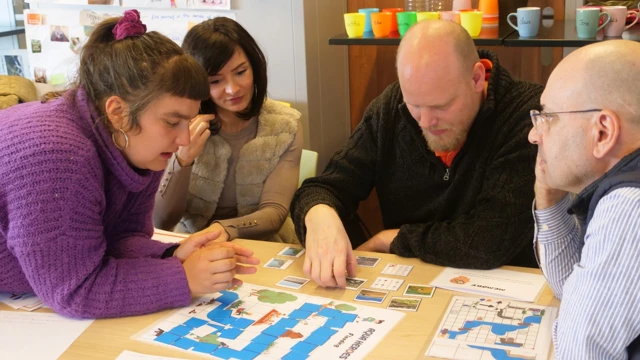
In the Games for Goals project, four European universities of applied sciences from the Netherlands, Germany, Belgium, and Portugal worked together with three NGOs to develop educational games designed to introduce primary school pupils to the SDG’s.
The collaboration took place through annual ‘mobilities’: intensive project weeks in which international student teams co-designed a game around a sustainability issue. In total, they developed three games , now translated into five languages and made freely available, along with an accompanying methodology on quality sustainability education.
An achievement to be proud of, but according to Philippa, the process was just as valuable as the product. “Students learned to collaborate in an international context, to uncover implicit cultural values, and to engage with different perspectives on learning, teaching, and motivation. Some partners from other countries, for example, viewed students primarily as producers of a final result, while at Inholland we aim to create space for personal growth and to nurture intrinsic motivation.”
These conversations about values led to something essential: “Students learned to reflect together, to align, and to make differences explicit and discussable. They learned to truly listen, to let go of assumptions, and to create something new together. They developed a shared working culture and a common language. That experience is at least as valuable as the game they created.”
ESC-IDG Hub
Many students – and lecturers as well – feel overwhelmed by the scale of societal issues such as climate change, social inequality, and the transition to a circular economy. They want to make a difference but often don’t know where to begin.
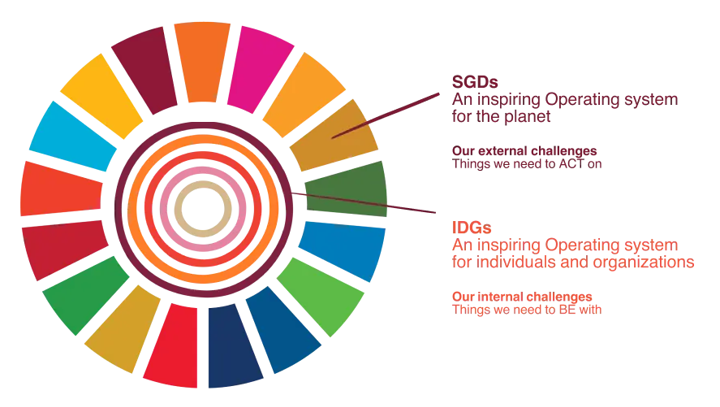
To address this, the IDG Hub was founded in collaboration with the Expertise Network for Systemic Co-Design: an interactive meeting space where research is conducted into people’s concerns and motivations for action. At the same time, the hub is a place where societal transitions and sustainability issues are addressed collectively and systemically, grounded in the Inner Development Goals (IDG’s).
Together with colleagues, Philippa developed a practical training program for students to explore these inner skills. The training consisted of a short introduction, followed by interactive exercises and reflection moments. The design was accessible, but the effect profound. “Students recognized themselves in the themes. They interacted with each other more openly, felt more connected to themselves, to others, and to the world around them. This created trust and a sense of agency.”
The ESC-IDG Hub applies a dynamic approach with the student at the centre. “The gap between knowing and doing is large. The IDGs help students bridge that gap, starting with themselves”, Philippa explains. “It’s not about knowing more, but about getting to know yourself better so that you dare to take action – based on your own values, within your own discipline.”
Collaboration as a force for change
What connects both projects is the understanding that sustainable collaboration does not emerge automatically. It requires awareness, language, practice, and the courage to move forward – even step by step. “By guiding students in their personal development and taking them seriously as partners in the learning process, we create space for genuine collaboration. And that collaboration is essential for sustainable development and for creating a world we want to live in”, says Philippa.