

Professionals, students and policymakers in dialogue on regenerative tourism
On Thursday 11 December, the public event Possibilities for Regenerative Tourism took place at Pakhuis de Zwijger. The gathering was part of a multi-day programme on regenerative tourism within the European ConnAct project, a collaboration between Pakhuis de Zwijger, the Municipality of Amsterdam and Inholland University of Applied Sciences. Researchers, students, policymakers and professionals came together to explore how tourism can contribute to urban liveability, wellbeing and social cohesion.
Regenerative tourism: a different way of thinking and working
Central to the evening was the question of what regenerative tourism means in practice. Rather than a fixed definition, it was discussed as a different way of thinking and working: place-based, long-term, and rooted in close relationships with local communities and ecosystems. Regeneration was framed as a process that grows through hyper-local, small-scale experiments, in which learning, testing and co-creating with residents help build lasting value for place.
From theory to practice: pioneers and policy
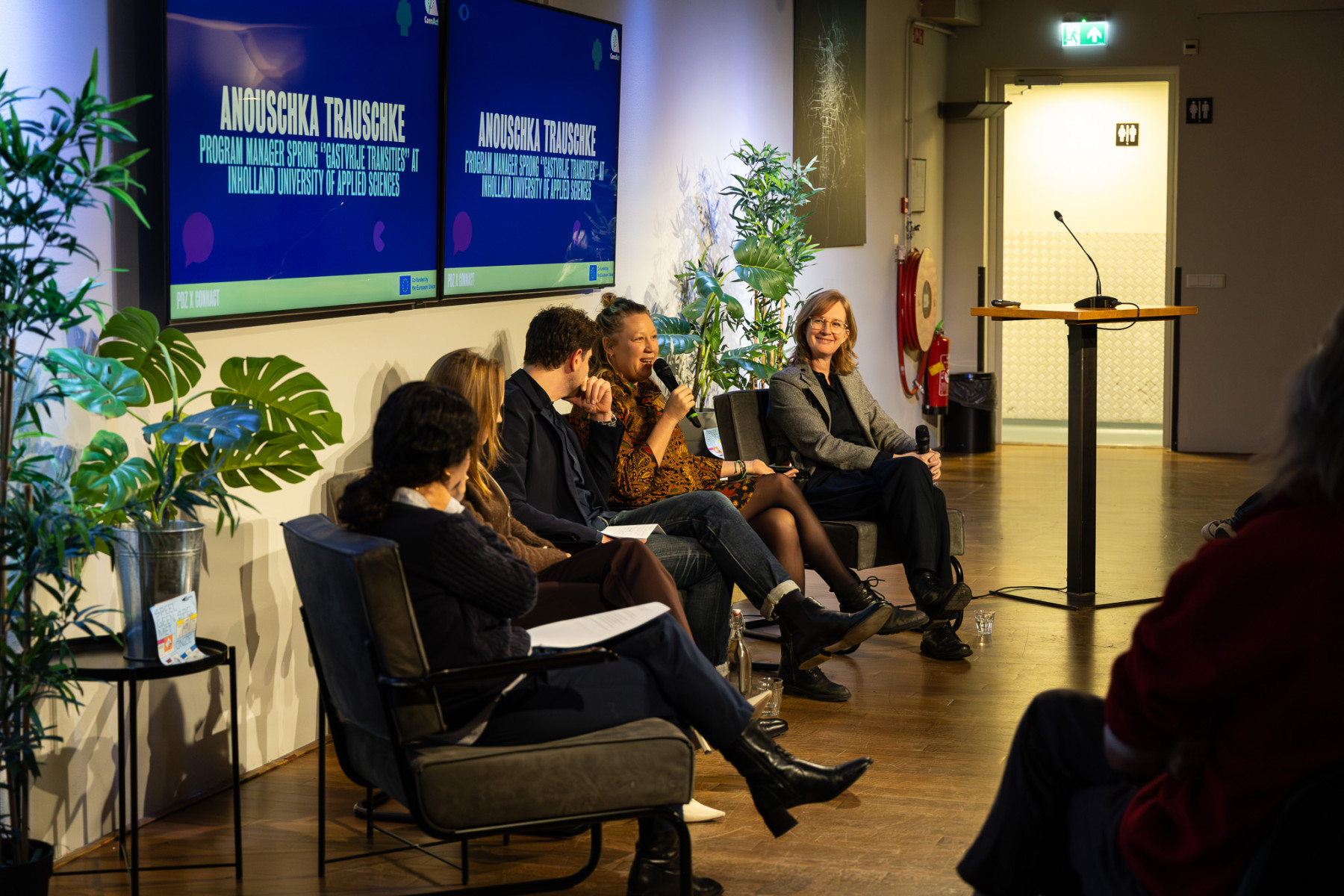
Roos Gerritsma (Urban Leisure & Tourism Lab) reflected on regenerative thinking inspired by living systems and demonstrated how this approach is embedded in applied research and education. Anouschka Trauschke highlighted the role of regenerative pioneers in Amsterdam and the wider Metropolitan Region, where small-scale initiatives show how tourism can contribute to local value creation.
Concrete examples, including neighbourhood initiatives, locally rooted food projects and Buurthotel, illustrated how tourism can strengthen neighbourhood identity and social connection. The role of policy was also addressed, with the Municipality of Amsterdam emphasising the importance of trust and societal value over quick or easily measurable returns.
Regeneration also requires inner change
The evening also featured a short embodied intervention by researcher Jimena Diamint. Through a guided mindfulness exercise, participants were invited to reflect not only cognitively, but also physically and emotionally on their relationship to tourism, place and one another. This intervention explicitly connected regenerative tourism to inner change and shifts in mindset.
Learning and designing in the city
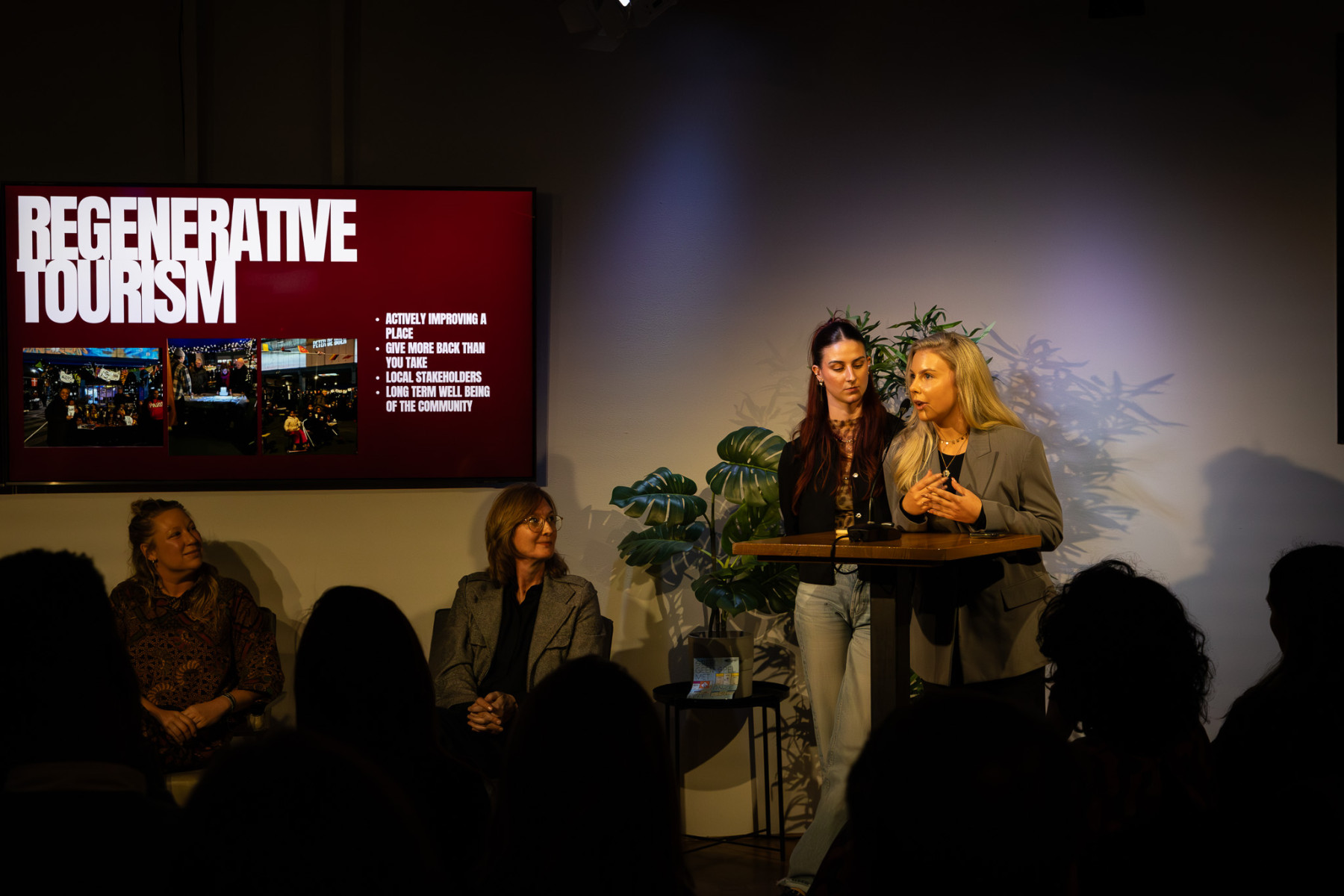
Students from the Urban Leisure & Tourism Lab presented projects from Amsterdam Noord, including a successful night market at Buikslotermeerplein, where local makers, projections and neighbourhood-based interventions were used to strengthen social connection, safety and pride of place.
Part of a multi-day programme
The event at Pakhuis de Zwijger was part of a broader programme. It followed a session at the Urban Leisure & Tourism Lab, presented by lab coach Zac Woolfitt, and was preceded by the Regenerative Tourism Hack: a mini-hackathon at Inholland University of Applied Sciences, organised and facilitated by ENSUT project manager Luca von Prittwitz and Jimena Diamint. During this session, students, researchers, professionals and EU partners explored how AI can contribute to a regenerative and inclusive visitor economy, and where alternatives are needed that place human connection, creativity and democratic values at the centre.
Regenerative tourism as a shared exploration
The evening demonstrated that regenerative tourism is not a buzzword, but a shared exploration that grows at the intersection of research, education, policy and practice.
More information and a recording of the event are available on the Pakhuis de Zwijger website.